
Cherokee VINELink County Scope
Kansas Victim Information and Notification Everyday is free, confidential, voluntary, available around the clock, and supported in many languages. The Kansas Attorney General describes it as a county-jail service. That boundary is the most important fact on the Cherokee County VINELink inmate check: Kansas VINE expressly excludes offenders housed in Kansas Department of Corrections prisons.
The service can report custody changes for an adult offender held at Cherokee County Jail when the participating feed supplies the record. It may allow search and registration through VINELink or by telephone at 1-866-574-8463. A person transferred from the jail to KDOC leaves this notification scope. Search KASPER and use KDOC Victim Services when eligible. BOP, USMS, and ICE also have separate routes.
| Custody system | Correct public channel | What it can confirm |
|---|---|---|
| Cherokee County Jail | Kansas VINE and sheriff Released roster | County custody status and reported change |
| Kansas state prison | KASPER and KDOC Victim Services | KDOC location, history, supervision, or eligible notice |
| Federal prison | BOP Inmate Locator | BOP custody record and recorded or projected date |
| Immigration custody | ICE ODLS and ERO | Covered ICE custody or recent release |
Search a Cherokee County Inmate
Begin with exact spelling, but do not select the first matching name without comparing the facility and identifiers. A name can collide with another person's name, and agency data can use a variant or alias. The goal is one matched county-jail record, not a broad list of people.
- Open the Kansas VINE gateway and follow its VINELink link, or call the statewide number.
- Select Kansas and the custody or offender search.
- Enter the full name and any offered identifier. If no match appears, try reasonable spelling variants.
- Compare the facility, identity details, and record identifiers for every possible match.
- Open the correct record and preserve the exact custody-status wording and retrieval time.
- Check the sheriff's Released roster or call 620-429-3897 to confirm a reported release.
The live VINELink Kansas search provides the interface used for the one-person lookup and registration.
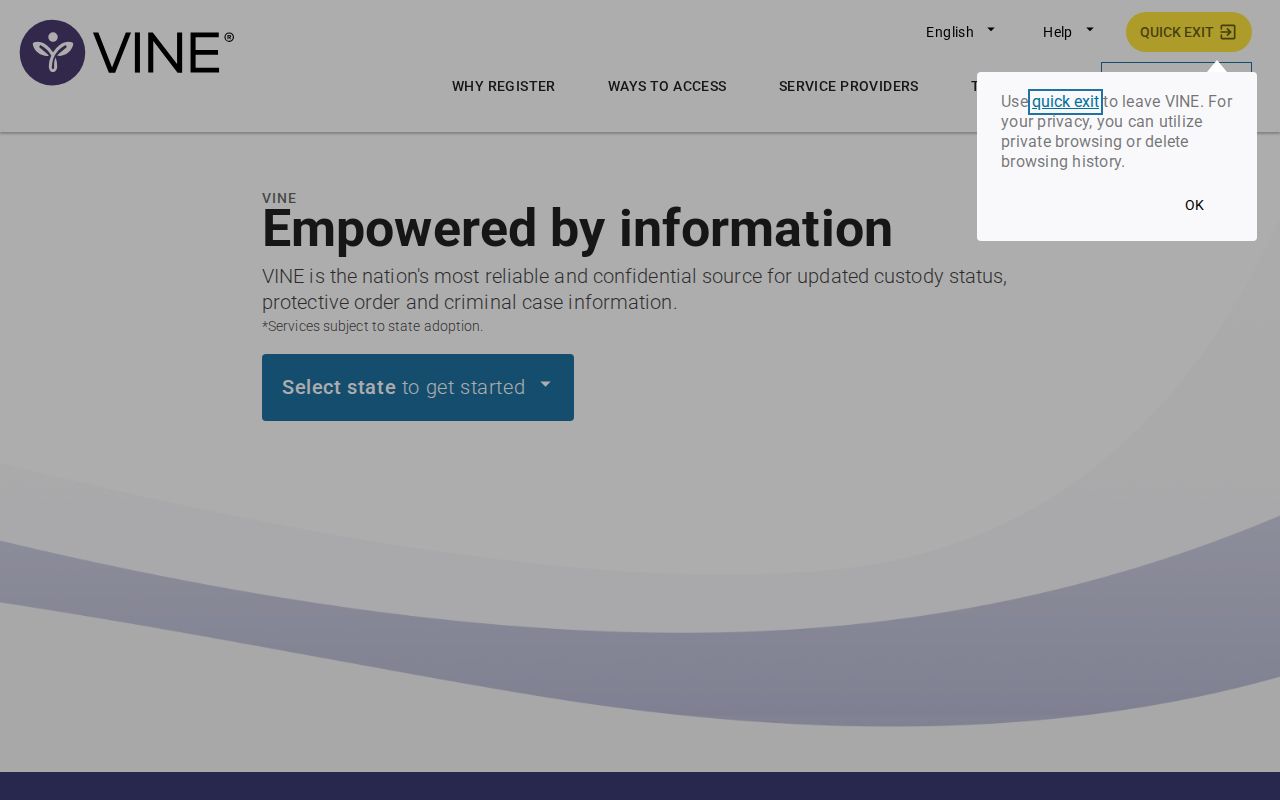
The captured screen shows the search environment, but live fields can vary. Always use the wording and options displayed for the matched Cherokee County record.
Cherokee VINELink Release Fields
A VINE result is a custody-status record, not a court disposition. Field availability can differ by agency and live system state, so avoid promising a booking photo, release reason, or scheduled prison date. Preserve labels exactly rather than translating them into a broader claim.
| Field | What it supports |
|---|---|
| Name and identifier | Matching the specific custody record when compared with other details |
| Facility or agency | Which participating county-jail source supplied the status |
| Custody status | Whether that source currently reports custody or a release change |
| Event date or time, when shown | Timing attached to the reported VINE event |
| Notification options | Which phone, email, text, or app methods the live interface offers |
A released status supports the fact that the participating county jail reported a custody change. It does not state that charges were dismissed, bond caused release, all holds cleared, or another agency did not take custody. The sheriff release record confirms local out-processing, while the court docket can explain legal authority.
Register Cherokee County Release Alerts
Registration should occur while the matched person remains in custody. Select the record, choose the notification option, and supply the destination offered by the live service. Keep contact information and the telephone PIN private. The PIN acknowledges a call; it is not an offender identifier.
- Open the verified in-custody record and choose registration.
- Select telephone, email, text, or in-app delivery when the current interface offers it.
- For telephone registration, create the required four-digit PIN and finish confirmation.
- When a voice call arrives, listen to the message and enter the PIN followed by the pound sign to acknowledge it and stop repeat calls.
- For email, no PIN is required. Kansas guidance says one email is sent for the custody-status change.
- Write down the alert time and exact status, then verify it with the sheriff feed or jail.
Text and app options should be followed as shown in the live interface. Never publish a registrant's contact destination or PIN. If an alert concerns urgent safety, use the appropriate public-safety channel rather than waiting for a web record to update.
Cherokee Alert and Roster Timing
VINE and the Cherokee County Released roster can update at different times because they record and transmit related events through separate systems. Jail staff may complete out-processing, the roster may change, and VINE may ingest the event later. An automated alert can arrive before or after the web card changes. That timing gap does not by itself make either source false.
When a notice arrives, record its wording and time. Next, open the newest-first sheriff Released filter and look for the exact release timestamp. Call the jail when the event is absent or time-sensitive. For a lasting record, request the existing release or out-processing record. Court entries may explain the order but do not prove the minute the person physically exited.
Missing Cherokee VINELink Results
A missing record is not proof of release. Spelling, data transmission, participation, retention, or a transfer outside county-jail scope can explain the result. Search the sheriff's Current and Released views, then call the jail or request its existing record. The Cherokee County released inmate search explains how to connect the county event to court and receiving-system records.
If the person entered KDOC, search KASPER. For qualifying victims, KDOC Victim Services provides a separate registration route. That program is not available merely because someone is in county jail, ordinary probation, or community corrections without KDOC supervision. Federal and ICE records must be checked in their own systems.
Cherokee Release Record Chain
Several records may be needed because each source proves a different part of the event. The VINE alert supports the custody change sent through the participating jail feed. The sheriff's Released card supplies the local release timestamp and booking identifiers. The jail's existing out-processing record is the stronger source when an official document is needed. A court docket can show bond, dismissal, sentencing, or another order that ended legal authority to detain in that case.
None of those records alone proves that the person returned to the community. A transfer to KDOC, another county, USMS, or ICE can follow a county release without a break in physical confinement. When the destination is not public, ask the jail whether a public transfer notation exists and search the likely receiving system. Keep the county release time separate from any later release by that agency.
Names can also collide. Preserve the booking number, facility, age or birth information when lawfully shown, and event time. Compare those details before joining a VINE notice to a sheriff card or court case. A photograph can assist, but it should not be the only identity match.
Confirm Cherokee VINELink Releases
Use VINE as a prompt to verify. It does not replace the originating record. A release reason, destination, court outcome, and later supervision require different sources. Start with the Cherokee County sheriff for local out-processing. Read the district or municipal docket for the order and case result. Follow KASPER, BOP, or ICE only when the custody path calls for that system.
For an older event that no longer appears, request the sheriff's existing booking and release records by name, approximate date, and booking number when known. Ask for the release date and time, release or out-processing form, and a public destination or transfer notation if recorded. The agency need not create a new explanation, and a missing online card does not mean the underlying record ceased to exist.
County and court records also answer different parts of a release. The sheriff's exact timestamp supports physical out-processing. A district or municipal docket may show bond, release conditions, dismissal, sentencing, probation, commitment, or another order that explains why local detention authority changed. Court entry time can differ from the jail's exit time. When docket shorthand is unclear, obtain the underlying order instead of treating the short label as a full account of the event.
Notification registration has its own timing limit. Find and register for the person while the record still shows county custody. If the person has already been released, VINE may show the reported change without offering the same future-alert options. Keep the telephone PIN confidential and use it only to acknowledge calls. Email needs no PIN and generates one message for the change under the Kansas instructions. Current text or app choices should be taken from the live interface because delivery options can change.
Route a transfer by its receiving system. A person committed from Cherokee County to a Kansas prison belongs in KASPER, and eligible notification requests go through KDOC Victim Services. A federal prison record belongs in the BOP locator. USMS custody may require the federal docket because there is no public historical USMS release locator. An immigration transfer belongs in ICE ODLS and ERO. None of those routes expands Kansas VINE beyond its stated county-jail scope.
Note: Kansas VINE is a county-jail notification service and must never be described as tracking all Kansas inmates.