
Cherokee County Release Records
Release from Cherokee County Jail means that one booking episode has ended at that facility. The sheriff’s public Released view ties an exact release date and time to a booking number. That is good evidence of local out-processing. It does not, on its own, say whether the person posted bond, completed a sentence, received a court order, or entered another agency’s custody. The safest wording is “released from Cherokee County Jail” until a second official source confirms what happened next.
Several paths may follow. A person can return to the community on bond, leave after time served, or be released under a court order. Another person can be transferred to the Kansas Department of Corrections, returned to a contract county, delivered on a warrant, or moved into federal or immigration custody. Parole and postrelease supervision also end prison confinement without ending correctional control. A discharge usually means the sentence or supervision has ended, but the precise KDOC history controls.
Cherokee County Release Paths
The legal event and the physical exit are separate facts. A court docket may show authority for release before jail staff clear holds and finish out-processing. The jail timestamp records the local custody event, while the court file explains the order. The receiving agency is the best source when custody continues elsewhere.
| Release path | Meaning | Next record |
|---|---|---|
| Bond or recognizance | Local detention ends while the case continues | Jail record and court docket |
| Time served | A recorded county sentence or credit is complete | Release record and judgment |
| Court order | A judge authorized release for a stated reason | District or municipal docket |
| KDOC transfer | County custody ends but state custody begins | KASPER offender record |
| Federal or ICE transfer | Another government system assumes custody | Federal docket, BOP, or ICE locator |
City-police and state-agency arrests can also lead to a booking at Cherokee County Jail. The arresting agency and charge help route the search. A city ordinance case may remain in municipal court even though the person was housed at the county facility.
Cherokee County Release Record Fields
The public Released card is a recent discovery record, not a full discharge file. It shows enough detail to separate booking episodes and locate a court case. Profiles provide more identity and arrest information. Neither view states that all holds cleared, and neither publishes the destination or release reason.
| Field | What it shows |
|---|---|
| Name and booking photo | Identity clues that still require comparison with other details |
| Booking number | The strongest local key for one booking episode |
| Booking date and time | When that jail episode began |
| Release date and time | When the sheriff roster records local out-processing |
| Age, gender, and race | Profile details used cautiously to separate similar names |
| Charges and arresting agency | Clues to the right district or municipal court |
| Displayed bond | Bail information, not proof that bond caused release |
A fuller existing record may contain a release code, authorizing order, employee entry, property acknowledgment, receipt, hold, or destination notation. Public availability depends on custodian review. Ask for fields that exist rather than asking staff to create a new explanation.
The booking number should follow every later check. One person can have several Cherokee County booking episodes, and a common name may produce more than one result. Save the displayed booking and release times, arresting agency, charge text, and retrieval time before the recent card changes. Then use those details in the court search or written request. A photograph can help compare records, but it cannot resolve identity by itself. If the sheriff record and court file seem inconsistent, first ask whether they describe different events. The court time may mark an order, while the jail time marks completed out-processing.
Request Cherokee County Release Records
When an entry has rolled off the recent view, use the Kansas Open Records Act process. The county’s KORA form has requester contact fields, a description box, and delivery or inspection choices. Advance costs may apply, but the research verified no fixed price for this release record. A narrow request is easier to identify and review.
- Gather the full name, approximate booking and release dates, and booking number if known.
- Describe existing records, such as the booking sheet and release or out-processing record.
- Ask for release date, time, type, and destination notation only if those fields were recorded and are public.
- Request a booking photograph separately in its existing electronic format when needed.
- Choose inspection or delivery and wait for the custodian’s cost and access response.
County Clerk / Freedom of Information function
110 W. Maple, Room 131, Columbus, KS
620-429-9500 ext. 5
For a jail-status check, the Cherokee County Jail line is 620-429-3897. Staff may limit what can be given by phone. The written request remains the durable route for an older booking or a specific existing release document.
Was Cherokee County Bond Posted?
Every Released card carries a bond field, yet that number does not identify the release mechanism. Bail and charges may change after a court appearance. A nonzero amount does not prove payment, and zero does not prove time served. The profile itself directs readers to the jail for correct bail, charges, and case numbers.
Use the release timestamp to confirm the local exit event. Then read the court docket for a bond entry, recognizance order, dismissal, sentence, or other authority. The two records answer different questions. If they conflict, preserve both dates and ask the originating offices to explain their own entries.
Cherokee County Release Fees
County resolutions provide limited historical context. A 2011 resolution imposed a $45 booking and processing fee as court costs for specified people who were convicted, adjudicated, or diverted. A 2010 resolution authorized a work-release per diem of no more than $20 under the cited county authority.
Neither resolution proves that cash is collected at the release desk today. They concern court or detention status, and current application must be confirmed. Do not delay a pickup or assume a person remains held because of either published figure. The jail and court clerk can identify any current, case-specific requirement.
Find Cherokee County Released Inmates
Start with the official sheriff source for a recent county-jail departure. Match the booking number, age, booking time, charge, and arresting agency rather than relying on the name or photo alone. A person still shown under Current has not yet been reported as released by that view. If both views are blank, absence is not proof of release.
- Open the sheriff’s newest-first Released roster.
- Compare the person’s card and profile with known booking details.
- Check the Current roster when no release card appears.
- Use the district or proper municipal docket to identify the legal event.
- Search the receiving system if the court or jail indicates a transfer.
- Call the jail or submit a focused KORA request for older or missing entries.
The official Released roster is visible in the captured source below. It shows the actual card format and timestamp placement used for recent Cherokee County releases.
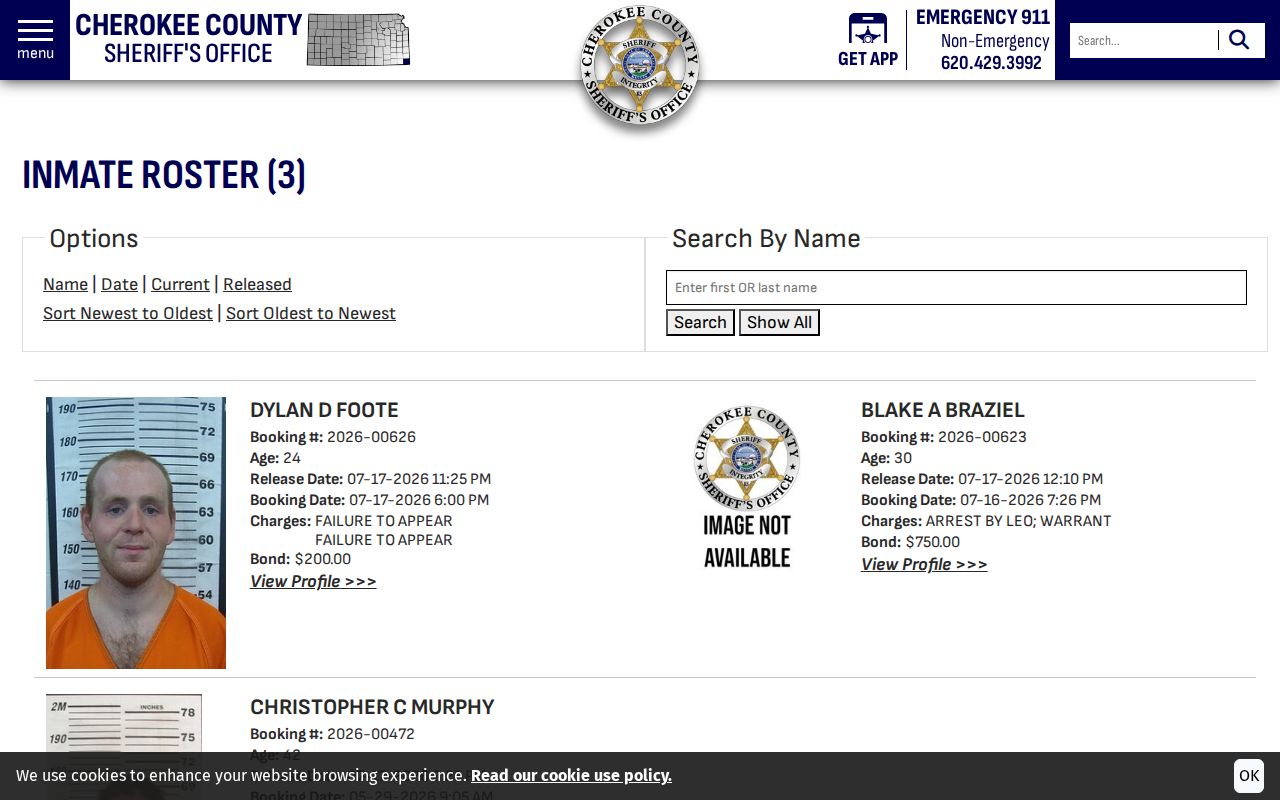
The card provides a local release timestamp, while the jail record and court or receiving system supply deeper confirmation.
If a person vanished from Current but is absent from Released, try the sheriff’s name search and reasonable name variants before drawing a conclusion. A feed delay, correction, alias, expired recent card, or booking under different identifying data can explain the gap. Call the jail with the full name, approximate booking date, and booking number when available. Ask whether that booking was released or transferred and how to request the public record. If telephone disclosure is limited, submit the narrow KORA request. Next, check the court for a release order, dismissal, bond entry, sentence, or commitment. A court order can authorize release without proving the actual exit time or clearance of another hold.
Who Processes Cherokee County Releases?
The sheriff’s jail operations page identifies distinct staff work behind the public timestamp. A Booking Officer receives prisoners and out-processes people being released. A Control Panel Operator controls entrances and exits, updates inmate rosters, and processes completed booking files. This supports the Released entry as part of an actual local workflow.
The jail does not publish release hours, a specific exit, weekend rules, or a property-return process. Call 620-429-3897 for current instructions. Do not infer a release schedule from old cards or arrive at an unlisted door based on a roster time.
The official jail operations page is shown below.
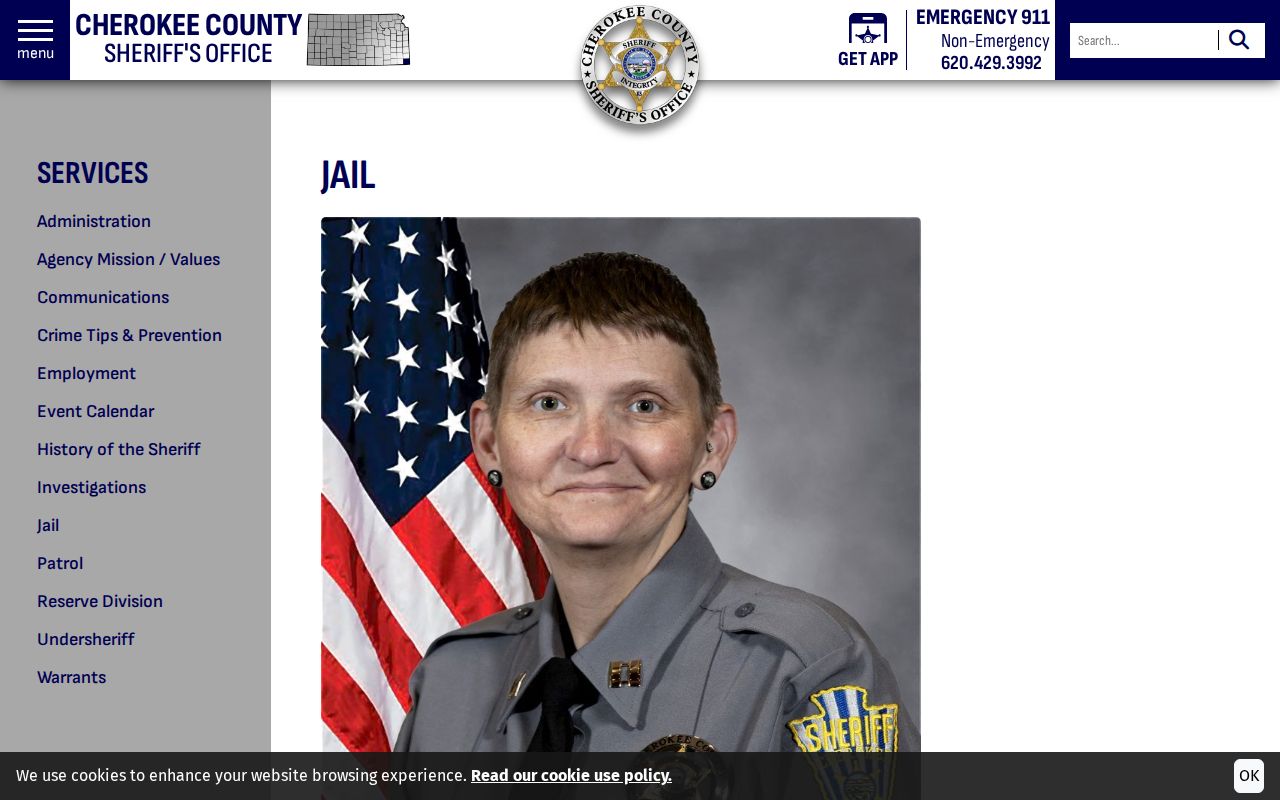
Those duties explain how a local exit reaches the roster, but they do not reveal the legal cause or destination.
Getting Home After Cherokee County Release
No sheriff-published pickup or ride process was found. The jail also does not publish a family waiting area, exit point, or jail-arranged transport. Anyone planning a ride should confirm timing and pickup instructions with jail staff before traveling.
Kansas transportation material identifies Class LTD in Columbus as a regional provider. That source does not promise jail pickup. Confirm eligibility, service hours, scheduling, and the pickup point with both the provider and jail. A roster timestamp is historical and should not be used to predict when a future release will finish.
Cherokee County KDOC Release Lookup
Use KASPER when a person was committed to the Kansas Department of Corrections. It is the Kansas Adult Supervised Population Electronic Repository and updates each working day. KASPER covers people and cases tied to KDOC-funded or operated programs. It is not a full criminal-history or county-jail archive.
| Search field | Best use |
|---|---|
| KDOC number | Strongest direct correctional match |
| Last, first, middle, alias | Initial person search |
| Date of birth or age range | Separate similar names |
| Conviction or supervision county | Narrow the record to Cherokee County ties |
| Facility, location, supervision type | Read custody and supervision context |
Open the full history. A community location or supervision entry may show prison release to parole or postrelease, not discharge. A facility transfer is still custody. KASPER also warns that certain community-corrections probation events after April 21, 2021 cannot display during modernization, so the supervising agency may need to confirm them.
For the strongest state match, begin with the KDOC number. If it is unknown, search name and then narrow with date of birth, conviction county, supervision county, facility, gender, race, or supervision type. Read the chronology instead of one status label. An absconder entry describes a supervision issue, not a new conviction or the original reason for release. A discharged entry and a release to supervision also mean different things. Cherokee County is served by the KDOC Pittsburg Parole Office for state supervision questions. Because KASPER updates each working day, a weekend movement may not appear at once. Preserve the state record number and ask KDOC when the public history conflicts with a court judgment.
The captured KASPER search and released record view demonstrates the state route.
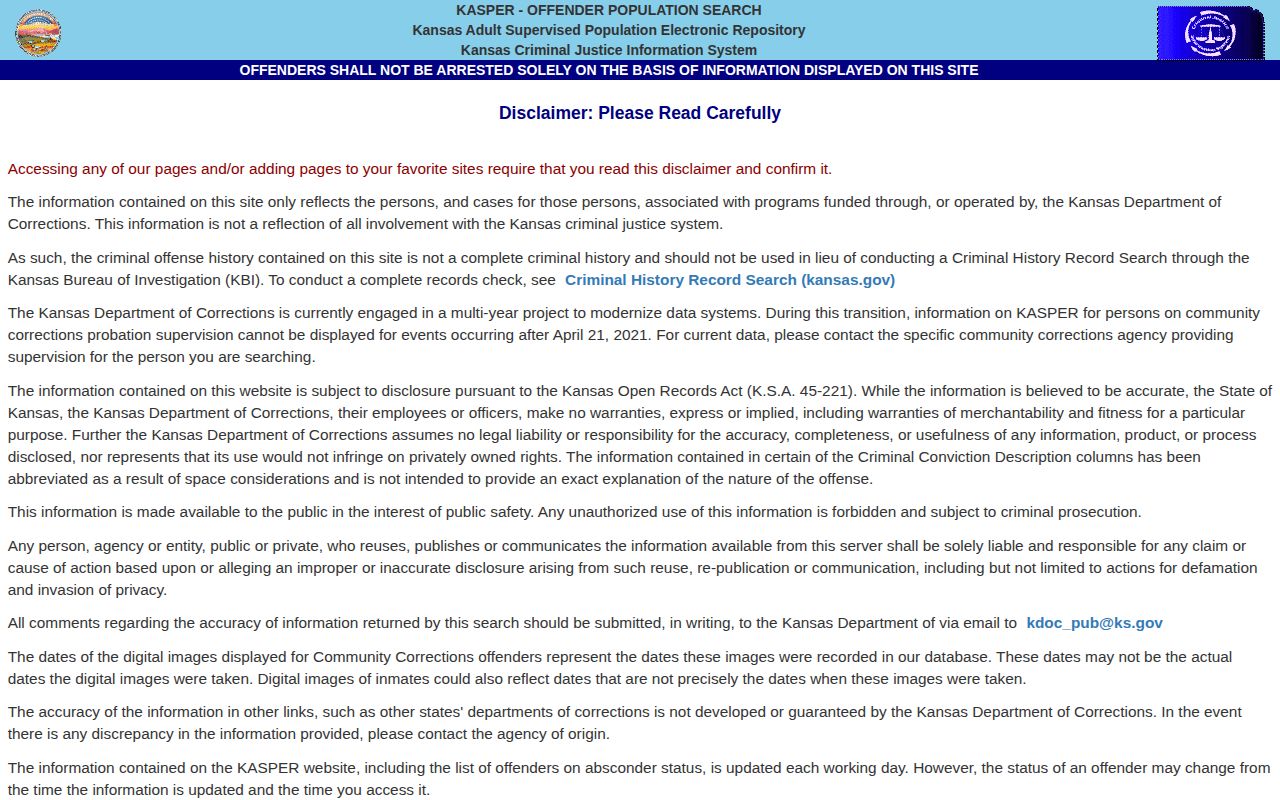
Use record numbers and custody history together because the KDOC image date may not be the photo date.
Cherokee County Court Release Proof
The jail record proves physical out-processing. A court docket can show why release was authorized. Look for bond, recognizance, dismissal, judgment, sentence, probation, revocation, or commitment entries. Court entry time can differ from the jail’s release time because staff must receive the order, clear other holds, and complete the exit process.
Arresting agency matters here. State felonies and misdemeanors generally point to Cherokee County District Court. A city ordinance matter may remain in Galena, Baxter Springs, or another proper municipal court. If a commitment entry sends the person to KDOC, the county exit is a transfer and KASPER becomes the next custody source.
Cherokee County ICE Release Transfers
An ICE detainer can change the meaning of release. ICE describes a detainer as a request for notice and for up to 48 additional hours so federal immigration authorities can assume custody. Thus, the county may record an exit even though the person did not return to the community.
Use the ICE Online Detainee Locator System and contact ERO when an immigration transfer is supported. No ICE jail or county contract was substantiated in Cherokee County. The county roster alone should never be used to infer an ICE transfer.
Cherokee County Expunged Release Records
Expungement concerns later access to qualifying records, not the date a jail booking ended. Kansas Judicial Council materials separate arrest-only expungement from conviction or diversion forms. Kansas Legal Services publishes clinic information, though the research found no Cherokee-specific clinic.
A missing online card may simply reflect the recent feed’s rolling nature. Do not infer expungement from disappearance. Check the court record and ask the custodian about the requested booking. A sealed, expunged, juvenile, or otherwise restricted record may be withheld under applicable law.
Cherokee County Custody Search Routes
Each system records a different population and event. Choosing the wrong source is the most common cause of a false conclusion.
| Situation | First source | Confirmation |
|---|---|---|
| Recently left county jail | Sheriff Released view | Jail phone or KORA record |
| Still in county jail | Sheriff Current view | Jail phone |
| Transferred to Kansas prison | KASPER | KDOC record |
| Released from Kansas prison | KASPER history | Pittsburg Parole Office or KDOC |
| Federal prison release | BOP locator | Federal docket or BOP record |
| Immigration custody | ICE ODLS | ICE ERO |
Kansas VINE can provide county-jail custody notifications, but it expressly excludes KDOC prison inmates. The KBI registry covers only people with qualifying registration duties and is not a general release list.
Cherokee County Release Facilities
The local facility is Cherokee County Jail. Three statewide systems cover transfers or releases beyond the county jail, even though no state prison, federal prison, or ICE detention center was identified inside Cherokee County.
- Cherokee County Jail: local booking, release timestamp, and KORA record.
- Kansas Department of Corrections: state prison and postrelease history through KASPER.
- Federal Custody in Kansas: federal dockets, USMS context, and BOP locator records.
- ICE Detention in Kansas: ODLS and ERO confirmation for immigration custody.
Confirm the event in the system that performed it. A release from one facility does not prove release from every form of custody.
Public Record Search
Sponsored Results