
Cherokee Projected and Actual Dates
A projected date is a calculation based on information held at that point. An actual release date records completed out-processing from the named facility or system. Those dates may match, but they answer different questions. A future date can change before release. The Cherokee County sheriff's Released roster supplies the actual local timestamp after jail out-processing, while KASPER may show state sentence, custody, supervision, and date fields whose labels vary by record.
A court order can provide legal authority at one time, jail staff can clear holds later, and the public roster can update after that. Each timestamp represents its own event. Keep the exact label and source. Never translate a maximum date, parole-eligibility date, or supervision-end date into a physical release date.
Cherokee Release Dates by Custody
Start by identifying who controls the person. The same name can appear in county, state, or federal records, but the rules are not interchangeable. Cherokee County has no identified KDOC prison, federal prison, or ICE detention facility. A local booking can still end in transfer to one of those systems.
| Situation | Date source | Main caution |
|---|---|---|
| Pretrial at Cherokee County Jail | Jail and court docket | No sentence-based projected date |
| Serving a county-jail sentence | Jail's recorded calculation and sentencing court | Do not import KDOC prison-credit rules |
| Determinate KDOC sentence | KASPER and KDOC calculation | Credit eligibility and sentence structure vary |
| Older parole-eligible sentence | KASPER, K.S.A. 22-3717, and PRB record | Eligibility or hearing does not grant release |
| Federal sentence | BOP locator and federal record | BOP date does not end federal supervised release |
Find a Cherokee Projected Date
The strongest state search uses the KDOC number because it identifies the correctional record more precisely than a name. KASPER is limited to people and cases linked to KDOC-operated or funded programs. It is not a county-jail archive and not a complete criminal history.
- Decide whether the person is pretrial, serving a county term, in KDOC, or in another system.
- For county custody, call Cherokee County Jail at 620-429-3897 and inspect the court docket. Ask for the existing recorded calculation, not a new estimate.
- For KDOC, open KASPER, accept the disclaimer, and search by KDOC number or name.
- Use date of birth, conviction county, supervision county, facility, location, or other advanced fields to separate matches.
- Open the full record and preserve the exact date label. Read it with sentence and custody history.
- Contact KDOC when the field is absent or conflicts with a court order. Do not calculate and publish an unofficial date.
The KASPER offender search is the official state entry point for a Cherokee County person committed to KDOC.
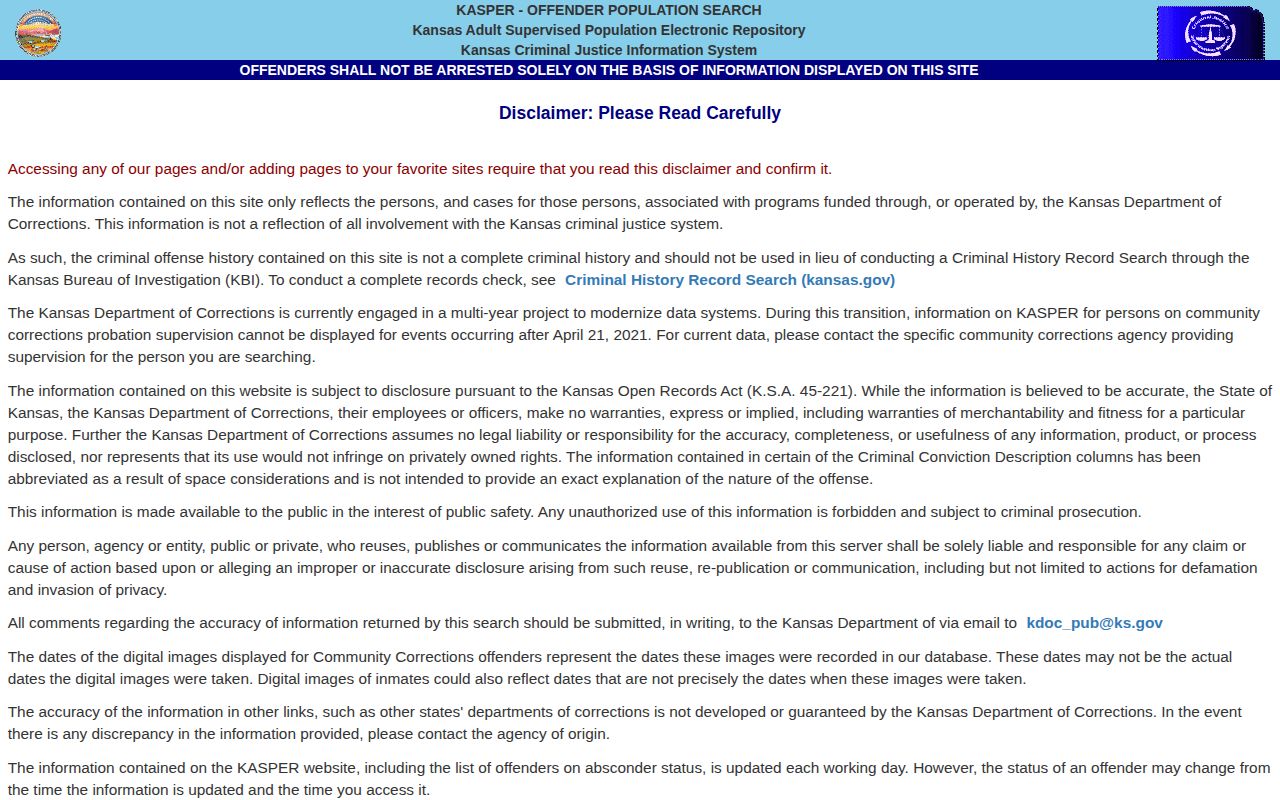
The interface demonstrates the state search and released or discharged context. Since fields differ by sentence, rely on the live record's exact wording rather than promising one universal projected-date label.
Cherokee Pretrial Release Timing
A pretrial Cherokee County detainee usually has no fixed release date. Bond can be posted, a court may order release, charges may change, or another hold may prevent departure. The bond amount displayed on a roster does not prove payment or establish why release occurred. A recognizance release may require no cash, and a later bond revocation can return someone to custody.
Read the court chronology for bond, conditions, dismissal, release order, or commitment. Then use the jail record for physical out-processing. The court entry time and jail exit time can differ. If the sheriff record shows release but the case continues, that is not a conflict. Pretrial release ends detention for that episode while the court case remains open.
Cherokee County Sentence Calculations
A locally sentenced person may have court-awarded jail credit and an administrative calculation by the jail. Research found no published Cherokee County good-time policy, weekend-release rule, or public date calculator. Ask the jail or court for the existing calculation and the sentencing order. Do not apply the Kansas prison percentages to a county term without an official basis.
Time served means credited confinement satisfies the custody ordered in the case. It can occur at sentencing or after a jail term, and it may coexist with probation, fines, registration, or another hold. The span between booking and release cannot prove time served because pretrial detention, concurrent cases, and sentence credit can affect the record.
Kansas Credits Affecting Cherokee Dates
K.S.A. 21-6821 sets the Kansas good-time and program-credit framework for covered prison sentences. For many crimes committed on or after July 1, 1993, available good time is capped at 15 percent. That cap creates the common phrase that a person may serve about 85 percent. It is not a universal rule and does not guarantee maximum credit.
Eligible nondrug severity levels 7 through 10 for crimes on or after January 1, 2008, and specified lower drug-severity categories and offense dates may allow up to 20 percent. The statute also permits up to a 120-day reduction of the prison portion for qualifying completion of designated programs, subject to exclusions and KDOC determination. Program credit is separate. It must not be stacked mechanically with the largest good-time figure to publish a homemade date.
Maximum credit must be earned and can be withheld or forfeited. Offense date, severity level, sentence structure, jail credit, consecutive terms, discipline, exclusions, and court amendments all matter. KDOC performs the official calculation.
The official Kansas credit statute supplies the controlling caps and program-credit authority.
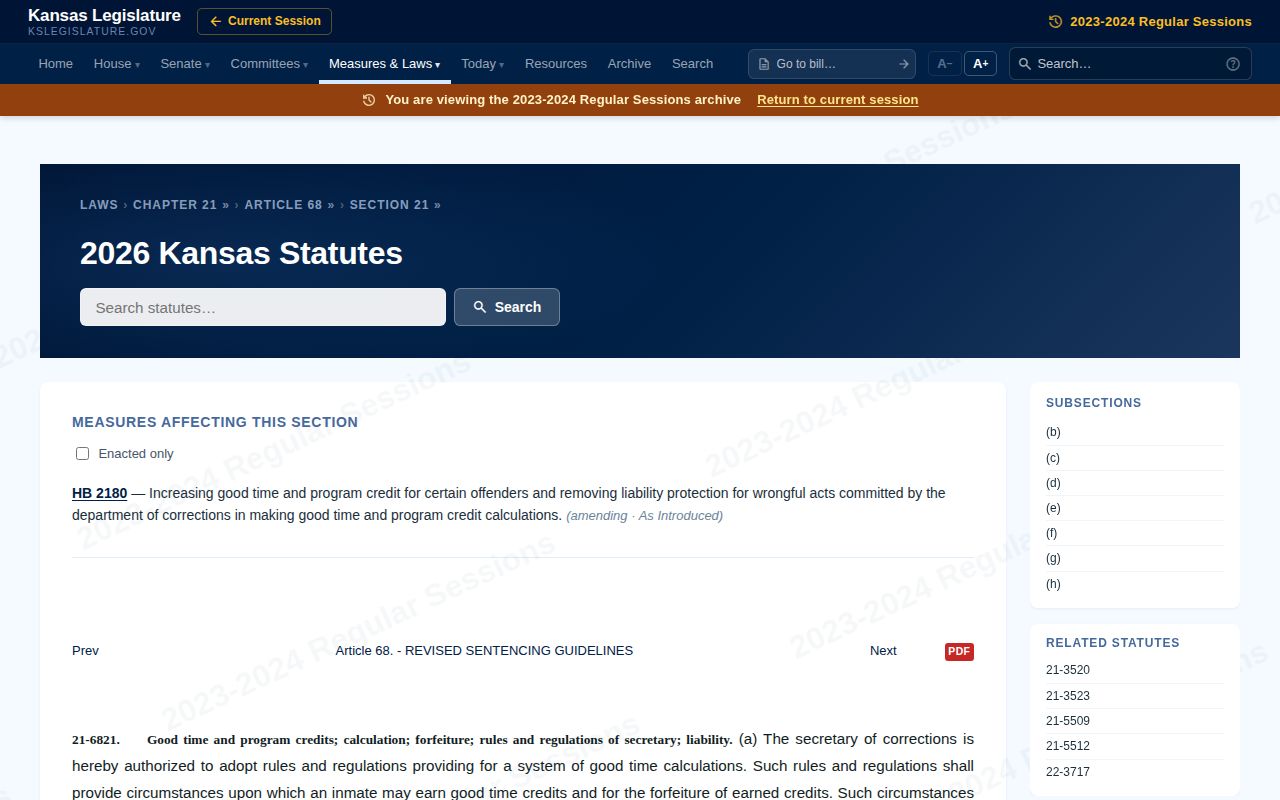
The statute supports the limits, not an individual calculation. The person's official KDOC record remains the source for the computed date.
Why Cherokee Release Dates Change
A displayed future date can move when the inputs or legal authority change. The cause should be confirmed from the agency record, not inferred from the new date alone.
| Factor | Possible effect |
|---|---|
| Credit award or forfeiture | Changes earned time within statutory limits |
| Jail-credit correction | Adjusts time credited toward the sentence |
| Discipline or program status | Can affect good time or qualifying program credit |
| Court or appellate order | May amend the sentence or credited time |
| Consecutive term or new case | Can extend custody beyond one case's date |
| Detainer or hold | Can cause transfer or continued custody after one release |
| Data correction | Updates a public field without a new legal event |
A county release to KDOC or ICE is still a release from county custody, but not freedom from confinement. Follow the receiving system. The Cherokee County released inmate search maps those custody branches.
Cherokee Parole Eligibility Dates
Older indeterminate Kansas sentences can involve parole eligibility under K.S.A. 22-3717. Eligibility is not release. A person listed for a Prisoner Review Board public-comment session remains pending until the Board acts and physical release occurs. Some offense categories have special mandatory periods, and life without parole is not eligible.
Most guidelines crimes committed on or after July 1, 1993 lead to postrelease supervision after the prison portion rather than traditional parole. Read KASPER and the PRB process record together. Preserve labels such as eligibility, hearing, maximum date, and discharge rather than calling all of them release dates.
Confirm Cherokee Actual Release
For the county jail, confirm completed out-processing through the sheriff's Released roster, the jail phone, or the existing release record. For KDOC, read the full KASPER history and request the relevant KDOC record if needed. A future field is not final until the correctional event occurs.
Kansas VINE can provide an alert for a person in county jail, but it excludes KDOC prison inmates. The Cherokee County VINELink check explains the phone PIN and county-only scope. State-prison notifications follow the separate KDOC Victim Services route for eligible registrants.
If two official dates conflict, record the label, agency, and retrieval time for each one. A court sentence date, jail release timestamp, KASPER sentence field, prison release, and supervision discharge can all be accurate while describing different points in the same case. Ask the custodian to clarify its own record rather than choosing the earliest or latest date. A dated screenshot can preserve a changing public field, but the originating record controls the event it reports.
Read the full sentence and custody chronology around any KASPER date. A maximum sentence date is not necessarily the day confinement ends. A parole-eligibility date means the law may permit review, not that the Prisoner Review Board granted release. A postrelease end date describes a later supervision endpoint. When KASPER presents only a historical date, do not turn it into a future projection. If no future field appears for the matched person, contact KDOC rather than filling the gap with arithmetic.
Consecutive and concurrent terms require special care. Consecutive sentences run in sequence, while concurrent terms overlap as the judgment directs. Jail credit may be corrected by the court, and an amended judgment can require KDOC to recalculate a public field. A detainer may keep someone confined under another agency even after the Kansas sentence reaches its recorded endpoint. New cases, appellate orders, and data corrections can also change what appears without making the prior screenshot fraudulent.
Older indeterminate cases add a separate decision stage. K.S.A. 22-3717 sets minimum service and special mandatory periods for covered offense categories. The PRB can act only within that authority. A listing for public comment or a scheduled review is still pending. Confirm the Board action in the proper record, then confirm actual movement through KASPER or KDOC. Eligibility, Board action, physical prison release, start of supervision, and final discharge should remain five separately labeled events whenever the record contains them. A denial, pass to a later date, or deferral must also retain the exact agency wording and must not be restated as a completed release.
Note: Never subtract maximum credits from a sentence and present the result as an official Cherokee County projected release date.