
KDOC Releases After Cherokee Cases
The Kansas Department of Corrections is a statewide correctional system, not a Cherokee County jail or local prison. A person committed from Cherokee County Jail to KDOC remains in custody after the county booking closes. The sheriff's Released timestamp then marks departure from the local jail, not release from confinement. KASPER, the Kansas Adult Supervised Population Electronic Repository, becomes the correct public locator once KDOC accepts the person.
Prison release can lead to parole or postrelease supervision. Parole generally applies to eligible older or indeterminate sentences and requires action within the Kansas Prisoner Review Board's authority. Postrelease supervision generally follows the prison part of a Kansas Sentencing Guidelines sentence. Both place a person outside prison while state correctional control continues. Discharge ordinarily marks the later end of the KDOC sentence or supervision shown in the official history.
A state record must be described by its exact endpoint. “Released from prison,” “on postrelease supervision,” and “discharged from KDOC” are not synonyms. Another case, warrant, or custody system may also exist. Attach each conclusion to the system and date that reports it.
Search KDOC Cherokee Release Status
KASPER covers people and cases associated with KDOC-funded or operated programs. It is not a complete Kansas criminal history and does not serve as an archive of all Cherokee County Jail bookings. A local detainee who was never committed to state corrections may not appear.
- Accept the KASPER disclaimer and use the KDOC number when available.
- Otherwise search by last and first name, then choose whether to include aliases.
- Narrow similar names by date of birth, conviction county, supervision county, facility, location, or supervision type.
- Open the matching record and compare identifiers and the image with care.
- Read the full custody and supervision chronology, not one status label.
- Record the retrieval date because KASPER updates each working day rather than instantly.
A location in the community or a supervision event can support release from prison, but not discharge. A facility change is a transfer. An absconder entry describes a supervision problem and does not erase the earlier prison release. If the record conflicts with a court order, preserve both labels and ask KDOC to reconcile its record.
The official KASPER capture shows the search route and released or discharged detail fields.
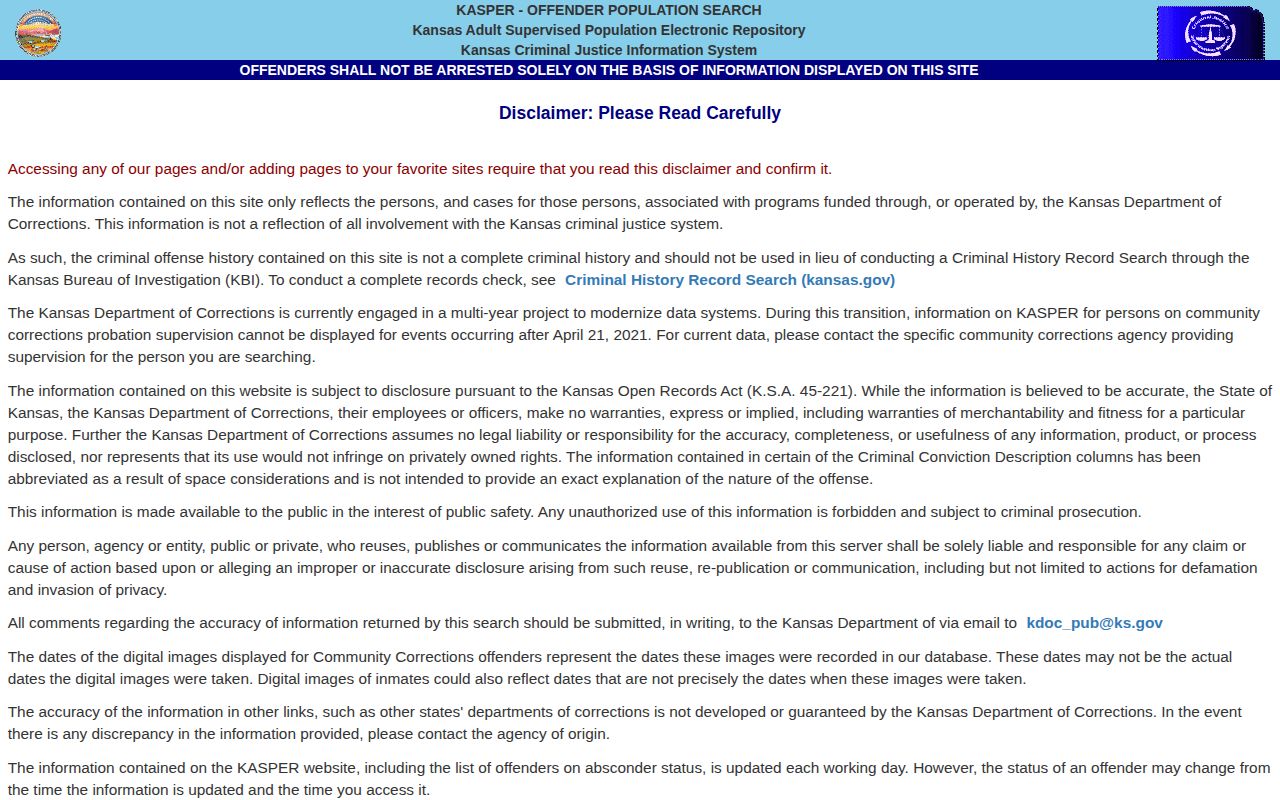
The image demonstrates where state identifiers, status, history, and any displayed release-date field must be read together.
Read KDOC Release Record Fields
KASPER search fields distinguish state correctional identities more reliably than a name alone. Advanced options include State ID or KBI number, date of birth, race, gender, age range, conviction county, supervision county, location, facility, and supervision type. Optional photo display can help, but KDOC cautions that the database image date may reflect when an image was recorded rather than when it was photographed.
| Field or event | What it supports | What it does not prove |
|---|---|---|
| KDOC number | Identity of one state correctional record | Identity of a county booking by itself |
| Facility or location | KDOC placement or status context | Local jail release details |
| Supervision | State parole or postrelease context | All court probation or absence of another case |
| Absconder | KDOC reports a supervision issue | A new conviction |
| Discharge event | End of the specified KDOC control | End of every legal duty or other custody |
A future-facing date must keep the exact live label. Sentence-end, maximum, parole-eligibility, and projected-release concepts have different meanings. KDOC performs the official sentence calculation, so no date should be recalculated from a statute or translated into a guaranteed exit date.
Cherokee KDOC Supervision Confirmation
For a Cherokee County connection, the Pittsburg Parole Office is the relevant regional KDOC contact identified in the research. It can confirm the correct state office and public contact route. It should not be asked for a person's private schedule, address, treatment details, or other protected information.
1008 W. 4th St.
Pittsburg, KS 66762
620-232-9550
Automated Reporting System: 866-570-7225
The official KDOC parole contacts are the source for current office assignments. The official capture shows the Pittsburg listing.

The office listing supports state supervision routing, not the minute a person left a prison.
KASPER warns that community-corrections probation events after April 21, 2021 cannot display during modernization. Probation is court-ordered community supervision and may occur instead of prison. A negative KASPER result cannot establish that someone is not on county or community-corrections probation. Use the sentencing court and the specific supervising agency for that status.
KDOC Parole Release Decisions
The Kansas Prisoner Review Board handles release decisions for cases within its statutory authority. A public-comment listing or hearing date means review is scheduled. It does not mean parole was granted or that physical release occurred. Verify the later status through KASPER and request the appropriate KDOC record when needed.
Most Kansas guidelines sentences for crimes committed on or after July 1, 1993 lead from the prison term to mandatory postrelease supervision rather than traditional parole. Older indeterminate cases can involve parole eligibility under K.S.A. 22-3717. Eligibility is only the point at which action may be considered. It is not an exit date.
The official board overview illustrates the agency route for those older or otherwise eligible cases.

Read board information with the KASPER chronology so a scheduled event is not mistaken for a completed release.
Request KDOC Release Records
For durable proof, use the KDOC online KORA request route. Give the full name and KDOC number. Ask for existing records that show release from confinement, placement on parole or postrelease supervision if applicable, and discharge from supervision. Do not ask the agency to create a calculation or offer an opinion.
A single KDOC file can contain several dates. Preserve each label. The prison-release date ends confinement in that KDOC episode. A supervision start describes the next phase. A discharge date may end correctional control in that case. The court judgment remains the durable source for the sentence itself.
KASPER questions may be directed to kdoc_pub@ks.gov. KDOC Victim Services is separate from Kansas VINE, which expressly excludes KDOC prison offenders. Eligible notification requests use the state corrections program, not the county-jail VINELink workflow.
Timing differences are common. A court judgment can establish a state sentence before the county completes transfer. A prison movement late on a Friday may not reach KASPER until a working-day update. A supervision office can hold the current operational record while the public history still reflects an earlier event. None of those times should be silently substituted for another.
Preserve the KDOC number, exact field labels, and retrieval time when a record matters. If a status remains unclear, state what KASPER reported and what the other official source reported. Contact the custodian for correction or context. A photograph should never decide the conflict because it can come from a different stage of the correctional history.
County court records remain important after the state takes custody. The judgment establishes the sentence and later court orders may amend jail credit or other terms. KDOC records show how the state administered that commitment. Reading both sources prevents a court event, prison release, and supervision discharge from collapsing into one inaccurate date.
KDOC Versus Cherokee Jail Release
The Cherokee County Jail and KDOC record separate custody layers. A county Released card establishes local out-processing. Commitment in the court docket and later KASPER placement can show that custody continued in the state system. Conversely, a person released from a Kansas prison may never return to the county roster even when the conviction began in Cherokee County.
| Person sought | First route | Durable confirmation |
|---|---|---|
| Recently left Cherokee County Jail | Sheriff Released filter | Jail record and court docket |
| Transferred into state prison | KASPER | KDOC record and judgment |
| Released from prison to supervision | KASPER history | KDOC record and Pittsburg office |
| Discharged from KDOC | KASPER history | KDOC KORA record |
Use the Cherokee County released inmate lookup when custody type is uncertain. Each conclusion should name the agency whose custody ended.
Public Record Search
Sponsored Results