
Cherokee County Three-Day Releases
The official Cherokee County Released view is ordered by release time, newest first. During research on July 18, 2026, its visible cards covered about three dates. That observation shows the page can support a useful three-day review. It is not a county promise that the page always holds 72 hours of releases.
No official page is titled “72 hour,” and the sheriff publishes no fixed retention period or update cadence. A quiet day can make the view look older. A busy period can shorten what remains visible. Corrections or late data can change the order. Treat the screen as a current snapshot, not a complete archive.
Calculate Cherokee County's 72 Hours
Record the retrieval time in Central Time before opening the list. Subtract exactly 72 hours. If the check occurs Monday afternoon, the cutoff is Friday afternoon, not the start of Friday. This approach captures the full rolling period and avoids treating three calendar dates as three complete days.
- Write down the current date, time, and Central Time designation.
- Subtract 72 hours to create the cutoff.
- Open the newest-first Released view and read downward by release timestamp.
- Keep cards at or after the cutoff and stop when a card falls before it.
- Confirm identity through booking number, age, booking time, charge, and arresting agency.
- Call the jail if a boundary entry, missing card, or conflicting status matters.
Use the 24-Hour Release List when the goal is a same-day check. Use the Cherokee County released inmate search when looking for one named person beyond the visible window.
Cherokee County Release Fields
Each card links several facts to one local booking. Those fields help prevent a false name match and establish when the jail marked the booking released. They do not establish the legal reason or final destination.
| Displayed field | How to read it |
|---|---|
| Booking photo and name | Identity clues tied to the booking; a photo alone is not conclusive. |
| Booking number | The best local reference for that single booking episode. |
| Age | A secondary match point that should be compared with other facts. |
| Release date and time | The exact value used against the 72-hour cutoff. |
| Booking date and time | When the displayed county-jail episode began. |
| Charges and bond | Displayed booking data that can change after court appearances. |
| Profile detail | Larger image, full name, gender, race, arresting agency, and charge detail. |
Release reason, destination, transfer agency, court result, sentence calculation, and supervision officer are absent. Do not translate bond into “bonded out,” a long stay into “time served,” or a release card into “case dismissed.”
Search Cherokee County Release Names
The sheriff provides a separate roster name search. It is helpful when the visible recent list is long, but spelling differences and repeat names can create weak matches. Search the exact name first, then reasonable variants. Open the profile and compare the booking number and dates.
The official name-search screenshot shows the county's direct person-lookup route.
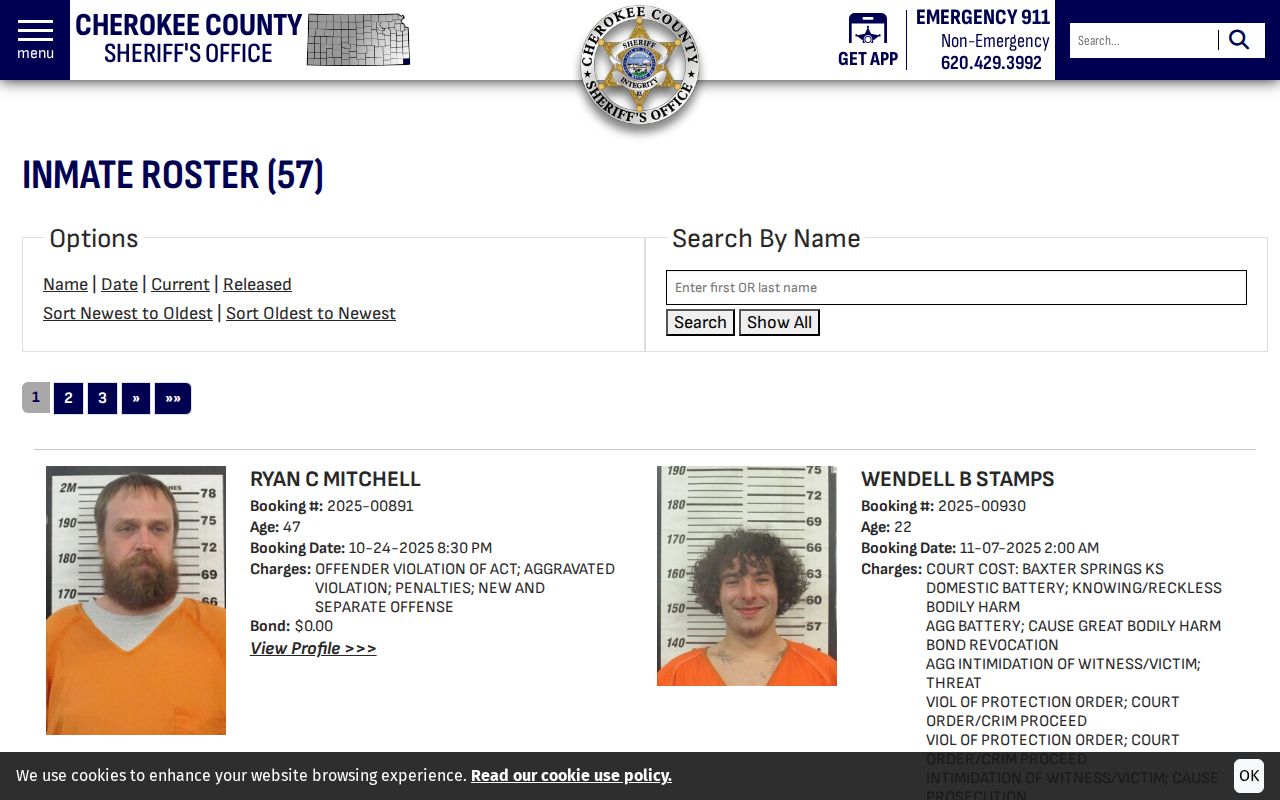
A name result still must be read against the 72-hour cutoff and confirmed through its booking fields.
No Promised Cherokee Release Window
The county's real Released toggle is unusually useful because it provides exact times and booking photos. Its limit is equally important: there is no stated duration, archive policy, or promise of completeness. The approximately three-date span seen during research could grow or shrink after publication.
Save the retrieval time and official URL when a result matters. If an older card rolls off, the underlying booking and release record may still exist. Online visibility and record retention are not the same thing. A missing old card does not mean the release never occurred.
Note: Do not publish a static count because the live roster changes.
Cherokee Weekend Release Checks
A 72-hour window is useful after a weekend because it reaches farther back than a same-day review. Still, Cherokee County publishes no special weekend or holiday procedure. Do not assume that releases stop, that the roster updates on a set schedule, or that Monday contains every weekend event.
Different records may show different times. A court can enter an order before jail staff receive it. Staff may then clear holds and complete out-processing later. A roster or automated notification can update after that. Record what each time represents instead of forcing the sources to match.
Interpret Cherokee Release Timestamps
A displayed Release Date is strong evidence that the county jail processed that booking out. It is not proof of return to the community. Cherokee County Jail houses sheriff prisoners, municipal and state-agency arrestees, contract-county prisoners, and some KDOC prisoners. A release from this facility can be a transfer to another custodian.
| What the timestamp supports | What it does not support |
|---|---|
| End of the listed county booking custody | Dismissal or acquittal in the case |
| Recorded local out-processing time | Release reason or court-order time |
| A specific booking episode | Freedom from all state, federal, or immigration custody |
Use the court docket for legal authority. Use KASPER if KDOC received the person. Use the relevant county, federal, or immigration system when transfer is plausible.
Recover Older Cherokee Release Records
Call the Cherokee County Jail at 620-429-3897 for a recent status. The sheriff FAQ also identifies open-record and jail contact routes. For durable proof, request the existing booking sheet and release or out-processing record through the County Clerk's KORA process.
Give the full name, booking number if known, and a narrow date range. Ask for the recorded release date and time, type or code if it exists, destination or transfer notation if public, and an electronic copy. The county may require advance cost payment, but no reliable fixed amount was verified.
Kansas VINE is a notification channel for participating county jails, not a historical archive and not a KDOC search. KASPER covers the state correctional population. A court file is the durable route to bond, dismissal, sentence, probation, or commitment entries. Together, those sources explain more than a recent card alone.
When official sources disagree, preserve the booking number and note when each source was read. The court order may precede jail out-processing, while the public card may follow it. Contact the office that created the disputed event. The court clerk can address a docket entry, the jail can address its release timestamp, and KDOC can address a KASPER status. Qualified wording is better than choosing one timestamp without knowing what it records.
The same rule applies to a transfer. Leaving Cherokee County Jail ends one custody episode, but it may begin another. A state commitment belongs in KASPER. A federal detention or release order belongs in the District of Kansas docket, with BOP used after a sentenced person reaches that system. An immigration transfer requires ICE's locator and ERO route. The county card alone cannot settle those later steps.
The sheriff's oldest-first Released view can assist with chronology, but it does not turn the roster into a permanent archive. Use it only as another way to inspect the live set. Record the newest-first URL when documenting a three-day review because that sort order makes the rolling cutoff clear. If the visible dates no longer reach the calculated boundary, state that the online view did not cover the full requested period and move to the jail or KORA record.
For a KORA request, identify the booking episode rather than asking staff to build a custom 72-hour list. Supply the full name, approximate booking and release dates, and booking number if known. Request the existing booking sheet and release or out-processing record, with the release timestamp and any public transfer notation. The agency need not create a new report. Asking for electronic delivery and a fee estimate can keep the request narrow.
Automated notice is a separate tool. Kansas VINE can report a participating county jail's custody change, but an alert may arrive before or after the sheriff card updates. The notice does not establish the court outcome, release reason, or destination. Write down its time and exact status wording, then compare it with the Cherokee Released filter. If either source remains unclear, the jail that created the local record is the confirmation point.
Public Record Search
Sponsored Results