
Cherokee Parole and Probation Compared
Parole, postrelease supervision, and probation can all place a person in the community under rules, but they do not arise in the same way. Traditional parole generally applies to an eligible older or indeterminate Kansas prison sentence and depends on action by the Kansas Prisoner Review Board. Postrelease supervision generally follows the prison part of a Kansas Sentencing Guidelines sentence. Probation comes from a district or municipal court sentence and may be ordered instead of prison or after a short jail sanction. It is not proof that someone was released from a state prison.
| Supervision | How it begins | Best verification route |
|---|---|---|
| Parole | PRB action for a parole-eligible prison sentence | KASPER history, PRB record, and KDOC Parole Services |
| Postrelease | Statutory term after the prison portion of a guidelines sentence | KASPER supervision fields and assigned parole office |
| Court probation | District or municipal court sentence | Court docket and the named probation agency |
| Community corrections | Court placement in a local corrections program | Court record and the specific community corrections office |
The distinction matters in Cherokee County because KASPER warns that community-corrections probation events after April 21, 2021 may not display during modernization. A blank KASPER result cannot prove that no probation exists. The court docket and assigned agency remain the proper route for that question.
- Parole
- Conditional community release from an eligible prison sentence before its final endpoint.
- Postrelease supervision
- A required period of state supervision after the prison portion of many guidelines sentences.
- Probation
- Court-ordered community supervision that may be imposed instead of prison.
- Discharge
- The recorded end of control by the named court or correctional system.
Verify Cherokee Post-Release Supervision
KASPER, the Kansas Adult Supervised Population Electronic Repository, is the first public check for parole or postrelease supervision tied to KDOC. It covers people and cases associated with programs operated or funded by KDOC. It is not a full Kansas criminal history, and a person who only had a Cherokee County Jail case may never appear.
- Search by KDOC number when it is known. Otherwise, enter the last and first name and decide whether to include aliases.
- Use date of birth, conviction county, supervision county, location, or supervision type to separate similar records.
- Open the full record. Read status, location, supervision type, supervision county, and the custody or supervision history together.
- For court probation, find the Cherokee County district or correct municipal case. Read the sentence, later violation entries, and discharge orders.
- Confirm state supervision through the assigned KDOC office. Confirm probation through the agency named in the court record.
KASPER updates each working day, so a recent movement may not appear at once. A community location can mean release from prison to supervision, but it is not the same as final discharge. Conversely, a discharge entry ends the referenced KDOC supervision and does not settle an unrelated court case. The Cherokee County release search supplies the separate jail-release path.
The official KASPER search shows the state fields and disclaimer used for this check.
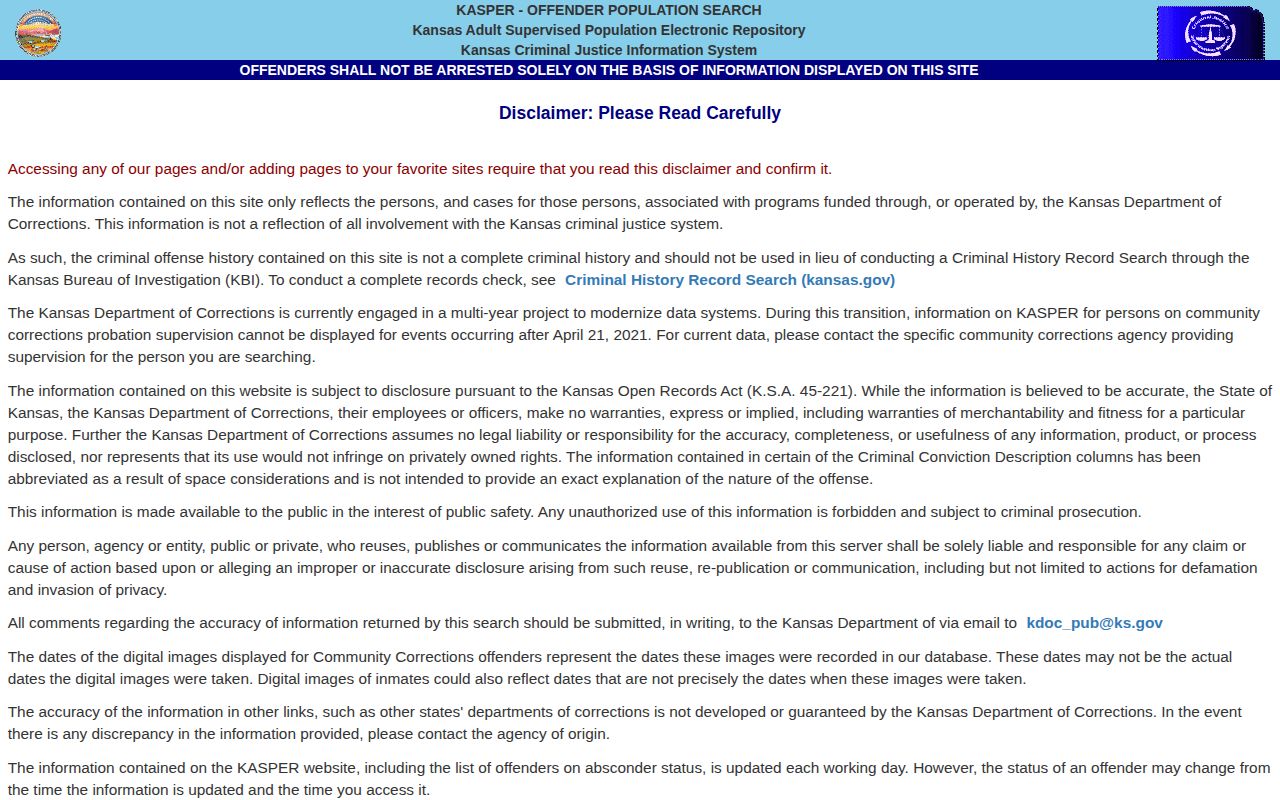
The screen illustrates why the complete correctional history must be read instead of treating one status line as the whole supervision record.
Cherokee State Supervision Office
KDOC assigns Cherokee County state parole and postrelease cases to the Pittsburg Parole Office in its South Region. The office also covers Allen, Bourbon, Crawford, Labette, Neosho, and Woodson counties. It can confirm the correct public contact route and current reporting directions. Staff should not be asked to disclose a person's private schedule, home address, treatment details, or other protected information.
KDOC Pittsburg Parole Office1008 W. 4th Street
Pittsburg, KS 66762
620-232-9550
Automated Reporting System: 866-570-7225
The KDOC parole-office directory is the source for the Pittsburg assignment and current contact information.

This office is the state-supervision contact. County or municipal probation must still be traced through the sentencing court and its named supervision agency.
Cherokee Supervision Status Terms
Conditions are rules attached to supervision. They can include reporting, travel limits, payment duties, program participation, or compliance with court and agency directions, but the exact terms come from the individual order. A violation allegation does not by itself prove a new crime. It may lead to an agency response, a warrant, a revocation filing, or a hearing, depending on the form of supervision and the record involved.
An absconder designation means KDOC reports loss of contact or noncompliance. It does not create a new conviction and does not erase the earlier prison release. KASPER is the state source and updates absconder information on working days. For a possible probation violation, inspect the court docket for a warrant, motion, hearing, or revocation entry. A person may also have a local warrant that has nothing to do with parole.
Cherokee Warrants After Release
Cherokee County's distinctive local route is the sheriff's felony-warrant and Most Wanted page. It also offers text and email updates. The channel may show that someone became wanted after release, but it is not a parole-absconder database and should never be described as one. Compare identifiers and then verify the active record with the originating office.
The Cherokee County felony-warrant page is the official local source.
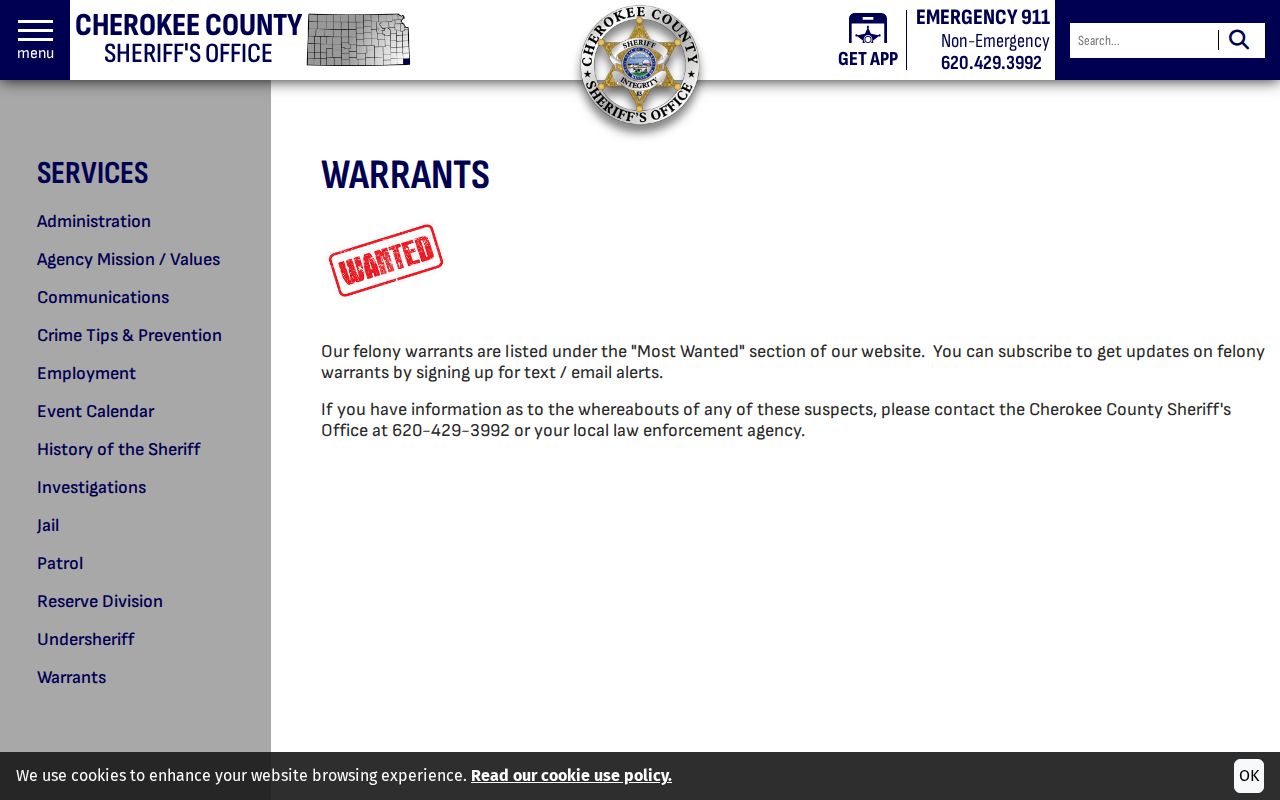
Use that page for local warrants and KASPER for KDOC absconder status. A name on either page must be matched with more than a photograph.
Cherokee Parole Eligibility Records
The Kansas Prisoner Review Board handles decisions within the authority set by K.S.A. 22-3717. Most guidelines sentences for crimes committed on or after July 1, 1993 lead to mandatory postrelease supervision after the prison portion, not traditional parole. Older indeterminate sentences and specified categories can follow parole rules. Eligibility only means the Board may consider the case when the law allows. It does not mean release was granted.
The PRB publishes a public-comment schedule and a separate list of people set for comment sessions. No distinct official decision-search database was verified. A listing shows a pending review event, not an outcome. After the event, check KASPER and request the proper KDOC or PRB record. Physical release must still be confirmed through the correctional record.
Cherokee Supervision Discharge Records
Supervision ends through an official discharge in the controlling system. For KDOC parole or postrelease, read the KASPER history and request the existing KDOC record if a formal document is needed. Provide the KDOC number and ask for records showing release from confinement, placement on supervision, and discharge from supervision. Keep each date under its actual label. A prison-release date, postrelease start date, and discharge date describe different events.
Probation ends through the court or supervision record. Look for a discharge or termination order, not merely the passage of the expected term. Revocation can instead return a person to jail or prison. A discharge from one case does not establish that every other case, registration duty, or form of supervision ended. Verification works best when each claim names the agency and system whose control ended.
Read the chronology before describing a state supervision endpoint. A prison-location entry, movement to a community location, parole or postrelease start, absconder notation, return to custody, and final discharge are distinct events. A person may leave prison and remain under KDOC control for years. A later absconder entry does not cancel the recorded prison release. It reports the agency's later supervision status. Likewise, a facility transfer is movement within custody, not release to supervision. Preserve the labels used by KASPER and match the KDOC number whenever possible.
When a formal state record is needed, use the KDOC public-records route and request existing documents rather than asking staff to form an opinion. Supply the KDOC number and ask for records showing release from confinement, placement on parole or postrelease supervision when applicable, and discharge from supervision. Several dates may appear in the response. Identify each one by its function. The date prison custody ended is not the date correctional supervision ended, and neither date automatically ends a separate Cherokee County court matter.
Court probation requires a similar document chain. Begin with the judgment or sentencing entry, then read later filings for conditions, violation allegations, warrants, revocation, modification, and discharge. Municipal ordinance cases may remain in the municipal court that imposed the sentence, while state-law cases proceed through district court. The agency named in that case is the correct source for current public verification. This route is especially important because KASPER's modernization notice limits public display of community-corrections probation events after April 21, 2021.
Note: Kansas VINE covers county-jail custody changes, not KDOC parole, postrelease supervision, or ordinary court probation.